National security
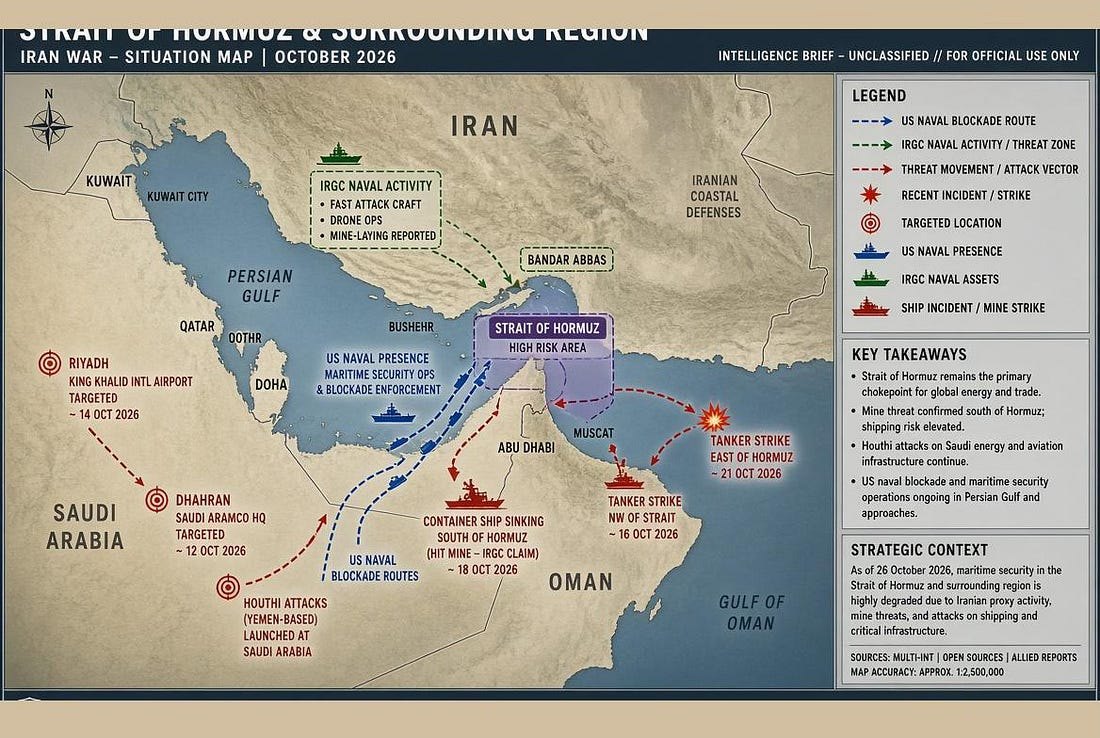
Iran’s Islamic Revolutionary Guard Corps (IRGC) Navy said Wednesday that a container ship carrying more than 2,500 containers sank south of the Strait of Hormuz after striking a naval mine while using what Tehran called an unauthorized route. The vessel caught fire, and the IRGC warned local craft about floating debris. Independent verification remains limited, and the IRGC has not released crew details or the ship's identity. This is the first sinking the IRGC has attributed to a mine during the war. It reinforces Tehran’s pattern of treating routes outside its control as hostile while talks continue, and President Trump has said no major U.S. strikes will occur before the 3 November midterms. Watch whether the United Kingdom Maritime Trade Operations (UKMTO) or U.S. Central Command (CENTCOM) confirm the loss, and whether further claims appear on the Omani side of the strait. (Reuters; Associated Press via The Gazette; The Independent)
Yemen’s Iran-aligned Houthis struck an administrative building at Saudi Aramco’s headquarters complex in Dhahran on Tuesday, producing a limited fire. Later reports indicate the damage was more extensive than initially described, with fire spreading across multiple floors of an office block; some functions have been shifted, and employees have been directed to work from home. Debris from intercepted missiles over Riyadh injured four people and damaged homes. The Houthis have vowed continued attacks on airports and oil sites in response to Saudi-led strikes on fuel storage and transport infrastructure in Sanaa, Hodeidah, and Dhamar. This exchange keeps pressure on Gulf energy infrastructure even as the broader U.S.-Iran fight remains in a declared pause. Watch for further Aramco or airport claims and any Saudi or U.S. decision on deeper involvement in Yemen. (Reuters; Reuters; Bloomberg)
Russian forces launched ballistic missiles, drones, and loitering munitions against Ukrainian targets overnight into 13 October but, according to available reporting, hit no energy facilities that day—the first such pause since President Trump announced an “energy ceasefire” on 12 October. Ukrainian President Volodymyr Zelenskyy had earlier reported multiple energy strikes after the announcement and said Kyiv had refrained from hitting Russian refineries. The Kremlin has not formally confirmed the arrangement. The announcement has not produced a stable halt in either direction. Watch whether the pause holds for a second night and whether Washington treats further Russian energy strikes as a violation. (Reuters; Al Jazeera)
Taiwan’s Ministry of National Defense tracked five People’s Liberation Army aircraft, six naval vessels, and four official ships around the island between 6 a.m. 12 October and 6 a.m. 13 October local time. Four of the aircraft crossed the median line into Taiwan’s air-defense identification zone. Later updates on 14 October showed continued activity, including additional sorties. Taipei is also monitoring a series of Chinese live-fire drills along the mainland coast scheduled to run for several days; Defense Minister Wellington Koo assessed the immediate impact on Taiwan’s waters as limited but said monitoring continues. The activity is consistent with routine gray-zone pressure rather than a new large-scale exercise. Watch the daily sorties and whether any of the coastal drills expand toward the strait. (Taiwan News; Ministry of National Defense, ROC)
Iran executed Ali-Sina Mostafavi on Wednesday after convicting him of carrying out armed attacks in Kerman earlier in the war in support of the exiled former crown prince. The judiciary outlet Mizan reported the case. Separately, Iranian officials have privately warned mediators that Tehran could target U.S. forces, naval vessels, or regional infrastructure more aggressively if major combat resumes, and some have floated the idea of sending forces into neighboring states—statements that remain unconfirmed as policy. These moves signal internal pressure on the regime and continued signaling toward the Gulf. Watch for further internal security operations or public threats tied to the nuclear or Hormuz talks. (Reuters)
Status of U.S.-Iran negotiations:
Intermittent U.S.–Iran negotiations aimed at ending the war that began with U.S.–Israeli strikes on 28 February 2026.
Those talks have covered two linked but distinct issues:
• Nuclear program. U.S. demands have centered on meaningful limits on Iranian enrichment (Vice President Vance publicly tied an end of the war to a reduction in enrichment capacity). Iran has rejected some U.S. proposals as “insufficient” and has conditioned any nuclear steps on broader concessions.
• Strait of Hormuz and the blockade. Iran has repeatedly stated that it will not fully reopen the strait or cease attacks on shipping until the U.S. naval blockade is lifted and other conditions (sometimes described as “seven conditions”) are met. Iranian officials have framed control of transit through Hormuz as their primary leverage.
Public reporting (Reuters and others) describes the discussions as continuing through intermediaries, with Trump saying the talks were “productive” while also ruling out major U.S. strikes before the 3 November midterms. No formal agreement has been announced, and both sides have continued military and maritime activity during the discussions.
Foreign policy
President Trump has stated that the United States will not attack Iran before the 3 November midterm elections and that discussions with Tehran are productive, while the naval blockade remains in place. Pentagon preparations for options continue, according to earlier reporting. The public pause has not stopped IRGC maritime claims or Houthi activity against Saudi targets. Watch whether any new proposal on Hormuz transit or enrichment appears before the election window closes. (Reuters)
Economic policy and markets
Brent crude traded near $106 and West Texas Intermediate near $95 on Wednesday morning as traders weighed the Hormuz mine claim, the Aramco headquarters hit, and ongoing Houthi threats against expectations of additional Russian diesel reaching markets under the recent U.S. arrangement. Prices remain roughly 45–50 percent above the February pre-war baseline. The increase reflects continued risk to Gulf flows rather than a full stoppage. (Reuters)
Domestic politics
The September Consumer Price Index is scheduled for release at 8:30 a.m. Eastern Time. Headline inflation is expected to rise to 3.6 percent year-over-year, driven in part by energy, with core readings watched for implications ahead of the Federal Reserve’s late-October meeting. Bank of America and Morgan Stanley report earnings. No new legislative action on security or the war is scheduled. Watch the inflation print for any shift in rate expectations that could affect the cost of sustaining the current posture.
Also worth knowing
Researchers in Europe and China reported the first working nuclear clocks based on the thorium-229 nuclear transition, published in Nature. The devices measure time using nuclear energy levels rather than electron transitions and could eventually reduce timing error to roughly one second over millions of years. The work is still at an early stage but opens a path for precision measurements that could bear on dark-matter searches or navigation systems. (The Debrief; Nature papers referenced therein)
Situation graphic — Iran war/Hormuz theater
The map below summarizes open-source reporting on recent maritime incidents, IRGC claims, Houthi strikes on Saudi targets, and the continuing U.S. blockade posture as of 14 October. Dates and locations reflect the latest available claims; independent confirmation of individual mine strikes remains incomplete.
Worth a second look
The Maritime Executive analysis on Iran’s bargaining position in Hormuz notes that Tehran’s ability to raise costs through selective attacks has not yet forced a change in the blockade or produced an agreement on its seven stated conditions. Gulf states continue to treat permanent Iranian control of transit in the Strait as a red line. (The Maritime Executive)
On the schedule today
• 8:30 a.m. Eastern Time: September Consumer Price Index (CPI) and Real Earnings (Bureau of Labor Statistics).
• Morning: Bank of America, Morgan Stanley, and BlackRock third-quarter earnings.
• 2:00 p.m. Eastern Time: Federal Reserve Beige Book.
• Equity markets open; continued monitoring of Hormuz and Saudi intercept reports.
• Additional Fed speakers (Bowman, Barkin) through the day.