Fiscal Risks of AI Displacing Human Labor on Federal Revenue
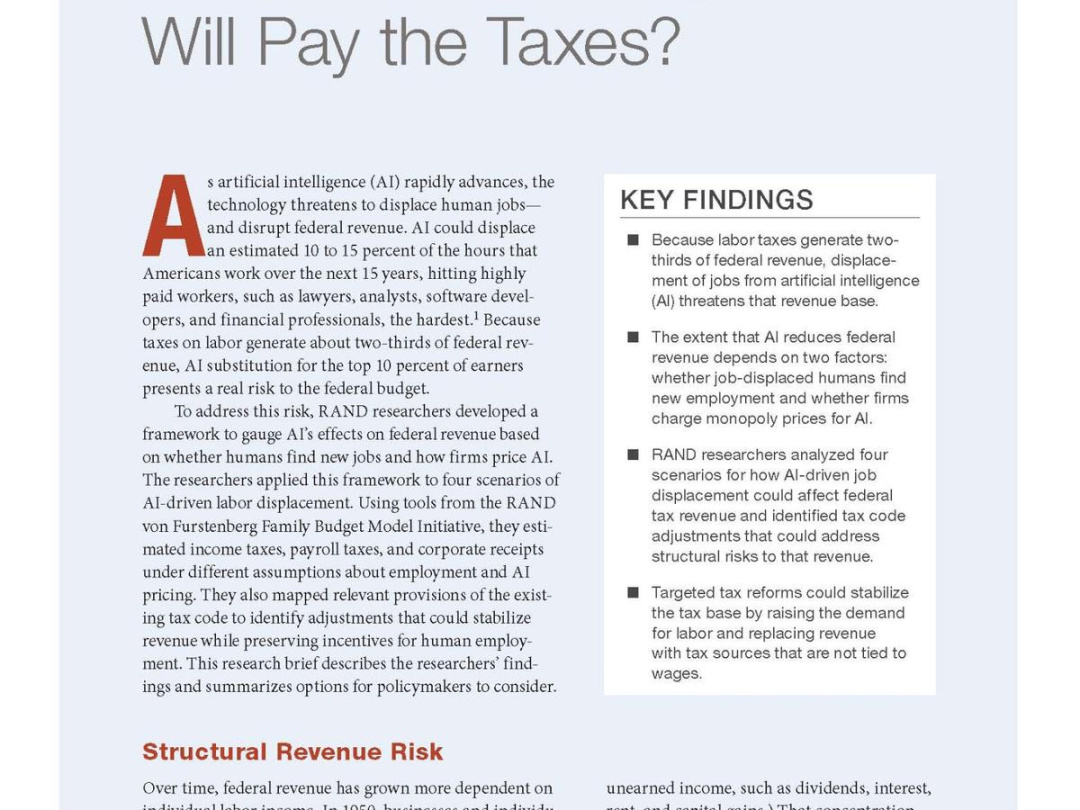
As artificial intelligence (AI) technology progresses rapidly, it threatens to displace a significant number of jobs, which in turn could disrupt federal revenue streams. According to a recent study by RAND researchers, AI could replace approximately 10 to 15 percent of the hours Americans work over the next 15 years, with high-income professions such as lawyers, analysts, and software developers facing the greatest risk. Given that labor taxes account for about two-thirds of federal revenue, this shift presents a serious challenge to the federal budget.
The RAND study developed a framework to assess AI's impact on federal revenue, focusing on scenarios where human workers either find new jobs or do not, and how firms price AI technology. The researchers simulated four distinct scenarios of labor displacement driven by AI. Their analysis revealed that the displacement of high-income workers could create a fiscal shock comparable to a recession, as the top 10 percent of earners contribute around 76 percent of federal revenue from individual income taxes.
Common Sense Shop
The United States of Common Sense
Amazon shopping links. Sponsor Complete!
Historically, federal revenue has become increasingly reliant on individual labor income. In 1950, businesses and individuals contributed roughly half of federal taxes each. By 2024, individuals' income and payroll taxes are projected to account for 84 percent of federal revenue. This heavy reliance on labor income makes the tax system vulnerable; a sustained drop in employment or a shift in how employers compensate workers could severely limit revenue collection.
The RAND report identifies two critical factors determining the severity of fiscal consequences from AI displacement: the pricing of AI technologies and the employment effects stemming from this transition. The researchers outlined four scenarios based on these factors, with scenarios where workers do not find new jobs posing the greatest risk to federal revenue. In particular, scenarios involving monopolistic pricing of AI technology could lead to increased corporate tax receipts, but only if displaced workers can secure new employment.
Tax Code's Role in Automation Incentives
In addition to the direct impact on revenue, the study highlights the unintended consequences of the current tax code, which incentivizes automation over human labor. For instance, employers face payroll taxes for each human worker but do not incur similar taxes for AI systems. This discrepancy, along with accelerated depreciation rules for automation investments, effectively subsidizes the replacement of workers with machines.
The Common Sense Test
To mitigate these risks, the researchers suggest that Congress proactively reform the tax code to eliminate incentives for replacing human workers. Options include narrowing the capital-labor tax rate gap and adjusting the payroll tax structure to better reflect the realities of an increasingly automated economy. Furthermore, they recommend tracking early indicators of these scenarios, such as declines in income tax revenue and the spread of low-cost AI models, to inform timely legislative responses.
The implications of AI on the labor market and federal revenue are profound. Policymakers must confront these challenges head-on to ensure a stable tax base in the face of rapid technological advancements. The potential for AI to reshape the job landscape necessitates a thoughtful and proactive approach to tax policy, one that balances the benefits of innovation with the need for sustainable revenue generation.